Ameresco Insights
How Layered Energy Infrastructure Improves Reliability
Published September 30, 2026

Ameresco Insights
Published September 30, 2026
Electricity demand is rising rapidly. The EIA expects total U.S. electricity generation to grow 2.5% in 2027, which would mark four consecutive years of growth for the first time in more than two decades. Electrification and artificial intelligence are changing how and when power is used, and interconnection timelines that once moved in months can now stretch into years. More than 1,800 GW of proposed generation is currently sitting in utility interconnection queues, a number that has climbed quickly. Organizations are having to rethink how they approach energy planning as a result.
Energy infrastructure planning increasingly requires looking at the full picture. A reliable system may include several technologies working together, each serving a different purpose. When those pieces are planned as part of the same strategy, organizations have more flexibility to address immediate reliability needs while preparing for future demand.
The consequences of an outage have changed as AI and data centers increase energy demand across organizations. An event that once caused only a temporary inconvenience can now result in lost production, compromised data, or an unmet obligation to a customer with independent uptime requirements.
There is also a second, longer-term consideration. Infrastructure must be capable of managing current disruptions while accommodating future growth, as a system designed only for the present may encounter a different limitation in time.
Reliability spans two timelines, today’s uptime and tomorrow’s growth, and a strategy must account for both at once.
The right energy strategy depends on the site. Geography, load requirements, utility constraints, cost considerations, and growth plans all influence what a facility can support and what it needs.
A manufacturing facility protecting a continuous production line has different priorities than a data center where even very short disruptions can affect compute operations. A municipality focused on modernizing critical infrastructure faces a different set of requirements. Even two facilities in the same industry may need different approaches once their local conditions and future plans are considered.
Site-specific conditions determine the right energy mix.
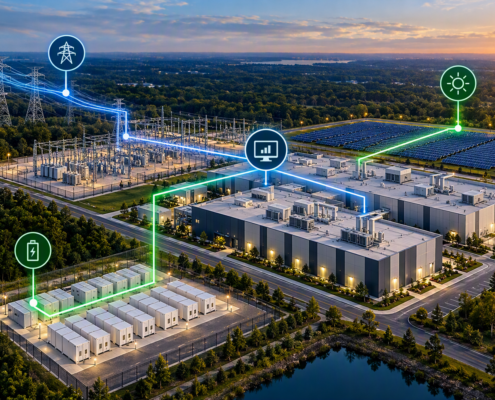
No single technology can meet every reliability need at a site, which is why the stronger approach is a layered energy infrastructure portfolio, a set of resources that each play a specific role:
How those pieces come together depends on the facility. Two Ameresco federal projects illustrate the difference.
A microgrid project at Joint Training Base Los Alamitos combines 31.5 MW of solar, a 40 MWh battery system, and 3 MW of emergency backup generation, designed to support islanded operations during emergencies. Under normal conditions, the project sends renewable energy to the surrounding community.
At Portsmouth Naval Shipyard in Maine, Ameresco was selected to design and install a 10.4 MW combined heat and power plant, along with gas turbines, steam generators, 14 MW of emergency capacity, and battery storage. Together, these components form a microgrid that is designed to help sustain critical shipyard operations during utility downtime.
Each project draws on a different combination of technologies, but both were built around the same goal: reliability when it matters most.
Resilience comes from how generation, storage, control, and grid infrastructure work together, not from any one component.
Choosing technology is only one part of the work. The harder part is developing, designing, financing, constructing, and operating the right combination of those technologies as a single, cohesive energy infrastructure strategy. Components need to be sized and sequenced around the site’s needs, rather than added independently over time.
That requires:
Ameresco’s federal data center project reflects this approach. Ameresco is partnering with the U.S. Navy on a planned 100 MW, AI-optimized data center at Naval Air Station Lemoore, where onsite generation was designed around the reliability demands of AI workloads from the outset.
Integration is what turns individual technologies into a functioning energy system.
Energy infrastructure decisions can shape how an organization operates for decades. Looking beyond the immediate project can help organizations account for growing demand, changing market conditions, and evolving operational requirements.
That means looking at the results an energy infrastructure strategy needs to deliver:
A long-term energy strategy should be measured by what it enables the organization to do, not simply by the technologies installed on-site.
Growing electricity demand is making energy infrastructure planning a more complex exercise. AI and digital infrastructure are adding significant new loads, while organizations across industries are also managing electrification, aging infrastructure, and longer timelines for connecting new capacity to the grid.
There is no single technology that addresses all of those challenges. The more practical approach is to consider generation, storage, controls, and grid infrastructure together, then determine how those resources should work together at a specific site.
While these challenges are reshaping energy planning across nearly every sector, data centers illustrate the need for layered energy infrastructure especially clearly. As AI and digital infrastructure accelerate demand for reliable power, organizations need integrated strategies that can support uptime, scalability, speed to power, and long-term growth. That makes data centers a useful example of how layered energy infrastructure moves from concept to real-world application.
Bottom line: Reliable power starts with the right combination of resources for the site and the way it is expected to operate.
How does layered energy infrastructure improve power reliability?
Layered energy infrastructure improves power reliability by combining generation, energy storage, intelligent controls, and grid integration into a coordinated system. Aligning these resources around a site’s operational needs helps support uptime during disruptions, improve resilience, and prepare for future electricity demand.
Why are organizations adopting layered energy infrastructure strategies as electricity demand grows?
Layered energy infrastructure helps address rising electricity demand, electrification, AI-driven loads, aging infrastructure, and longer utility interconnection timelines. Coordinating generation, storage, controls, and grid infrastructure can support reliability, scalability, operational flexibility, and long-term growth.
Why is there no one-size-fits-all solution for energy reliability?
Energy reliability depends on site-specific factors such as load requirements, utility constraints, geography, operational priorities, cost considerations, and future growth plans. A tailored energy infrastructure strategy helps align the right mix of resources with how a facility operates today and how it is expected to evolve over time.
Why is energy system integration important for reliable power?
Energy system integration enables generation, storage, controls, and grid infrastructure to operate as a coordinated energy system. Integrating these resources around a site’s needs helps support reliable power, accommodate future growth, and ensure energy infrastructure components work together effectively.
How does Ameresco’s microgrid at Joint Training Base Los Alamitos support energy reliability and resilience?
Ameresco’s Joint Training Base Los Alamitos microgrid combines 31.5 MW of solar generation, a 40 MWh battery energy storage system, and 3 MW of emergency backup generation. The project is designed to support islanded operations during emergencies while providing renewable energy to the surrounding community under normal operating conditions.


 Designing Power: Why Speed to Power Is Reshaping Data Center Development
