Ameresco Insights
Designing Power: Why Speed to Power Is Reshaping Data Center Development
Published October 6, 2026

Ameresco Insights
Published October 6, 2026
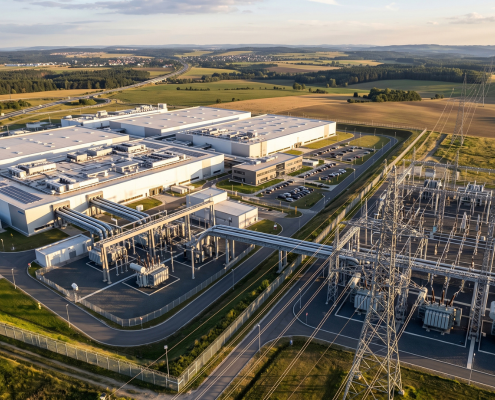
Data center development has traditionally been driven by factors such as land availability, permitting, and proximity to customers. Today, access to power influences project timelines, site selection, and long-term development strategies.
Across the industry, developers, investors, utilities, and large energy users are focused on a concept known as speed to power. Organizations may have the land, capital, and customer demand needed to move forward, but without timely access to power, projects can be delayed.
Speed to power is becoming a critical consideration in how projects are planned and executed.
Speed to power refers to how quickly reliable power can be delivered to support a new facility, expansion project, or large energy load. Historically, utility planning cycles were aligned with more predictable growth patterns. Today’s environment looks much different. The rapid growth of AI, cloud computing, and digital infrastructure is increasing demand for data center capacity and placing new pressure on the infrastructure needed to support it.
As noted in JLL’s 2026 North America Data Center Report, grid connection timelines for data centers still average four years or longer across much of North America. In response, developers are evaluating options such as phased load growth, flexible demand strategies, and supplemental power resources that can support construction, commissioning, and future expansion.
The focus on speed to power reflects a broader shift in how organizations view power infrastructure. Rather than treating power as a downstream utility requirement, developers are making energy strategy a core part of early planning and investment decisions.
A more diversified approach to power infrastructure is emerging, with solutions designed to accelerate deployment while maintaining reliability. The conversation is shifting beyond utility connections to a broader discussion about long-term power readiness.
The growing emphasis on power readiness is driving interest in a broader mix of grid-connected and distributed energy solutions to improve project certainty and support deployment schedules. Depending on project goals and site requirements, that may include onsite firm generation, battery energy storage systems (BESS), backup power solutions, and phased infrastructure strategies. As a result, energy strategy is becoming a more integral part of data center development.
The rapid growth of AI is bringing new attention to the infrastructure required to support the digital economy. Data centers sit at the center of that transformation, but success depends on more than computing capacity. It depends on the ability to secure and deliver reliable energy at scale. As demand accelerates, the ability to bring that capacity online efficiently may determine how quickly new projects move from concept to operation.
This article accompanies the latest episode in Ameresco’s Designing Power video series, “Why Are Data Center Developers Talking About Speed-to-Power?” Watch the video to explore how growing demand for digital infrastructure is elevating speed-to-power as a critical consideration for project development, energy planning, and long-term growth.
What does speed to power mean in data center development?
Speed to power refers to how quickly reliable power can be delivered to support a new data center, expansion project, or large energy load. Speed to power matters because access to power is increasingly influencing project timelines, site selection, and long-term development strategies as demand for digital infrastructure grows.
Why are data center developers focused on speed to power?
Data center developers are focused on speed to power because growing demand for AI, cloud computing, and digital infrastructure is increasing the need for data center capacity while placing greater pressure on the infrastructure required to support it. Timely access to power is becoming an important factor in project planning and execution.
How can power availability affect data center project timelines?
Power availability can affect data center project timelines because organizations may have the land, capital, and customer demand needed to move forward, but projects can be delayed without timely access to reliable power. As a result, power availability is playing a larger role in development planning and site selection.
Why is power infrastructure becoming a core data center development strategy?
Power infrastructure is becoming a core development strategy because organizations are incorporating energy planning into early project and investment decisions rather than treating power solely as a downstream utility requirement. This shift reflects the growing importance of power readiness in supporting deployment schedules and future development plans.
How are data center developers addressing long grid connection timelines?
Data center developers are evaluating options such as phased load growth, flexible demand strategies, and supplemental power resources to support construction, commissioning, and future expansion. These approaches are gaining attention as grid connection timelines across much of North America continue to average four years or longer.
What power solutions are data center developers considering beyond traditional grid connections?
Data center developers are exploring a mix of grid-connected and distributed energy solutions to improve power readiness and support deployment schedules. Depending on project requirements, these solutions may include onsite firm generation, battery energy storage systems (BESS), backup power solutions, and phased infrastructure strategies.
How is AI increasing the importance of power readiness for data centers?
AI is accelerating demand for data center capacity and increasing focus on the infrastructure needed to support the digital economy. As demand grows, power readiness is becoming more important because access to reliable energy can influence how quickly new data center capacity is brought online.
Why is reliable energy critical to the future of data center growth?
Reliable energy is critical to data center growth because data centers depend on the ability to secure and deliver power to support expanding digital infrastructure demand. As AI and other digital technologies continue to drive growth, the ability to provide reliable energy at scale is becoming an important consideration for new development.


