Ameresco
Designing Power: AI Is Creating a New Power Infrastructure Challenge
Published September 29, 2026

Ameresco
Published September 29, 2026
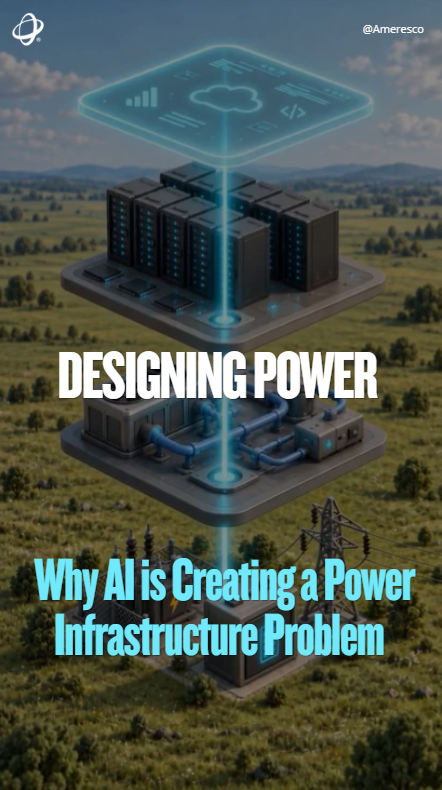
Artificial intelligence is often described as a digital revolution. The tools are digital. The applications are digital. The user experience feels almost invisible. But the infrastructure supporting AI is anything but virtual.
Behind every prompt, generated image, cloud upload, and AI-driven workflow are data centers, cooling systems, servers, and physical assets operating continuously to process and deliver the services many people rely on daily. What appears effortless onscreen is supported by an immense and growing demand for electricity in the physical world.
As AI adoption accelerates, a new challenge is emerging: can power infrastructure keep pace with demand?
For the past several years, AI discussions have focused on advances in models, computing capabilities, and application development. An underlying question is starting to shape conversations among technology companies, utilities, developers, policymakers, and infrastructure providers: Where will the power come from?
And the scale of projected demand is significant. The International Energy Agency estimates that global electricity consumption from data centers could grow from approximately 460 terawatt-hours in 2024 to more than 1,000 terawatt-hours by 2030, driven largely by AI workloads. At the same time, data centers are expected to account for more than 20% of electricity demand growth in advanced economies through the end of the decade.
Data centers were once viewed primarily as facilities that stored and processed information. Today, they are becoming foundational infrastructure for the modern economy. They support everything from cloud computing and financial systems to healthcare applications, industrial operations, research activities, and artificial intelligence (AI) workloads. As demand for digital services continues to grow, so does the importance of the infrastructure that powers them.
Today the industry sits at the crossroads of building additional computing capacity and ensuring sufficient power infrastructure is available to support that growth. In many regions, access to power is becoming a key factor in how quickly new facilities can be developed and brought online.
Although AI is drawing attention to today’s power challenge, the implications extend beyond the technology sector. Manufacturers expanding production capacity, healthcare systems modernizing facilities, educational institutions fostering the next generation, and municipalities investing in future development all depend on reliable access to energy.
The same power infrastructure that supports data centers also supports economic development, community resilience, and business growth. As energy demand increases, organizations are paying closer attention to how power is generated, delivered, managed, and maintained. Reliable access to energy is a strategic consideration beyond an operational requirement.
For decades, roads, bridges, rail networks, and ports helped support economic expansion by connecting people and goods. Today’s economy increasingly depends on a different kind of infrastructure. Power infrastructure is becoming a critical enabler of digital growth.
The organizations and communities best positioned for the future will be those that can secure, deploy, and manage the energy resources needed to support growing demand. The future of AI will be shaped by innovation in software and computing. It will also be shaped by the power infrastructure that makes those innovations possible.
This article accompanies the latest episode in Ameresco’s Designing Power video series, “Why AI Is Creating a New Power Infrastructure Challenge.” Watch the video to explore how growing AI adoption is increasing demand for power infrastructure and why reliable energy is becoming a critical factor in the future of the digital economy.
What is Ameresco’s Designing Power article "Why AI Is Creating a New Power Infrastructure Challenge" about?
Ameresco’s Designing Power article explores how rapid AI adoption is increasing electricity demand and creating new challenges for power infrastructure. The article explains the connection between artificial intelligence, data centers, and energy systems, highlighting why reliable power is becoming a critical requirement for digital growth.
Why is AI driving growth in electricity demand?
Ameresco explains that AI applications rely on data centers, servers, networking equipment, and cooling systems that consume significant amounts of electricity. As organizations adopt more AI-powered tools and services, demand for the infrastructure that generates, delivers, and manages power continues to increase.
Why are data centers important for artificial intelligence?
Ameresco describes data centers as foundational infrastructure for AI and the broader digital economy. These facilities support cloud computing, financial services, healthcare applications, research activities, industrial operations, and the computing workloads required to train and run AI technologies.
What power infrastructure challenge does AI create?
Ameresco highlights a growing concern across the technology and energy sectors: whether existing power infrastructure can keep pace with rapidly rising demand. Access to reliable electricity is becoming an important factor in determining how quickly new data centers can be developed and brought online.
How much electricity could data centers consume by 2030?
Ameresco cites International Energy Agency projections showing that global data center electricity consumption could grow from approximately 460 terawatt-hours in 2024 to more than 1,000 terawatt-hours by 2030. AI workloads are expected to be a major contributor to that increase.
Why is reliable power becoming a strategic business priority?
Ameresco explains that energy availability is evolving from an operational consideration into a strategic priority. Organizations are paying closer attention to how power is generated, delivered, managed, and maintained because reliable energy access increasingly influences growth, resilience, and long-term planning.
How does AI-related energy demand affect industries beyond technology?
Ameresco emphasizes that growing power demand affects manufacturers, healthcare organizations, educational institutions, municipalities, and other sectors. These organizations all rely on dependable energy infrastructure to support operations, expansion, modernization efforts, and future economic development.
How will power infrastructure influence the future of AI?
Ameresco states that the future of AI will depend not only on advances in software and computing, but also on the ability to secure, deploy, and manage the energy resources needed to support growing demand. Energy infrastructure will play an important role in enabling continued innovation.