Cost Savings
March 23, 2026
Ameresco Delivers Energy and Infrastructure Upgrades for Pittsylvania County

Share this post
At its core, geothermal energy captures heat stored beneath the earth’s surface and transfers it for use at the surface. In thermal applications, closed-loop systems circulate fluid through underground piping to exchange heat with the ground, providing efficient heating and cooling without combustion. In deeper reservoirs, that same principle of heat exchange drives turbines to generate electricity, 24 hours a day, regardless of weather or season.
blog content
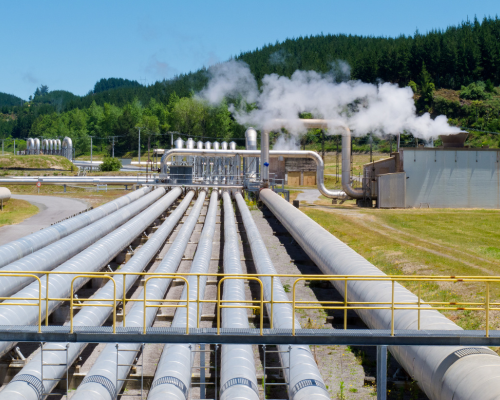
This combination of continuous operation and resource stability makes geothermal unique among renewables. It generates clean energy without requiring battery storage, reduces load volatility on the grid, and supports both distributed and centralized deployment. From a sustainability standpoint, geothermal systems provide long-term carbon reduction with minimal land impact and low lifecycle emissions.
Moreover, geothermal provides local control. Because systems can be sited near consumption points, they reduce transmission losses and strengthen regional energy resilience. This stability provides investors, developers, and operators with a degree of policy security not always afforded to newer technologies.
The scalable nature poses geothermal as a key contributor to national baseload capacity. For agencies and institutions seeking dependable, renewable energy with predictable economics, geothermal aligns technical performance with practical reliability.
Ameresco’s early geothermal projects focused on the thermal side: systems that circulate heat through underground loops to condition air efficiently. These systems proved the viability of consistent thermal exchange in varied climates and at institutional scale. As the technology matured, so did its potential. Enhanced geothermal systems now allow developers to reach higher-temperature reservoirs, where thermal energy can be converted directly into power.
Ameresco’s current initiatives explore these deeper resources where geology is most favorable, initially concentrated in the western United States and Alaska, and make use of partnerships with geologists, utilities, and technology providers to manage risk and improve site economics. With new tools for subsurface modeling and greater drilling efficiency, areas once deemed marginal are becoming economically competitive and there is significant room for expansion.
Geothermal supplies heating, cooling, and electricity from a single source system, maintaining output regardless of external conditions. Its operating life spans decades with minimal surface footprint.
Unlike solar or wind, geothermal operates continuously, offering steady baseload generation without the need for storage, providing an always-on power source that smooths generation variability. This stability supports both grid reliability and localized control, particularly for federal and institutional clients with resilience goals.
Within Ameresco’s portfolio, it functions as a stable anchor resource that enhances system performance and resilience. For utilities and commercial operators, the ability to pair constant geothermal output with renewable peaks creates operational flexibility, improving both carbon performance and cost predictability.
Rapid load growth from AI infrastructure, expanding data centers, and broader electrification trends are causing immense pressure for new power generation. These demands require 24/7 energy sources that complement intermittent renewables. Geothermal meets that technical requirement but broader adoption is still limited by certain technical and practical gaps, chiefly, better site characterization, cost-effective drilling, and interdisciplinary expertise.
Geologists now play a larger role in evaluating potential resources, and their input directly affects project viability. Recent reporting from industry analysts, including Wood Mackenzie and The Wall Street Journal, notes a shortage of skilled geothermal professionals relative to market growth. As Ameresco scales its geothermal activity, collaboration across engineering, geology, and data modeling disciplines will determine the pace of adoption.
Geothermal energy is becoming an operationally significant component of the U.S. clean energy landscape. Because it qualifies for federal tax credits and remains largely insulated from shifting policy frameworks, geothermal occupies an increasingly strategic position in decarbonization portfolios.
Through combined experience in thermal infrastructure and new investments in power generation, Ameresco is applying technical expertise to a resource once limited by geography and cost. Continued innovation in drilling, modeling, and subsurface analysis will define how quickly geothermal scales, but its potential for providing permanent, carbon-free heat and power is already secured.
This free resource provides a tangible roadmap for organizations looking to reduce their carbon footprint and achieve net zero emissions. The built environment is responsible for roughly 40% of energy-related carbon emissions. This resource offers a holistic approach to cutting consumption, costs, and carbon and practical solutions for facility owners and operators.
 Ameresco Reports Fourth Quarter and Full Year 2025 Financial Results
