October 14, 2026
Roseburg Urban Sanitary Authority and Ameresco Celebrate Completion of Energy Infrastructure Project

Share this post
The technical need for energy storage emerges from several converging pressures. First, grid operators must smooth out demand spikes that occur over short intervals, which can drastically raise operating costs for businesses and stress underlying infrastructure. Second, critical industrial sites and remote communities demand higher power quality and instant backup capabilities. Sensitive manufacturing equipment and digital controls are vulnerable to voltage sags or momentary blips that cause unplanned shutdowns, often resulting in significant lost revenue, wasted labor, and production delays.
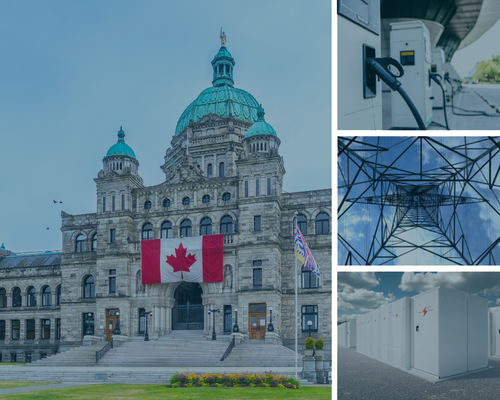
Traditionally, remote communities rely on diesel generators and aging infrastructure, facing frequent outages and environmental challenges. Ameresco’s battery installations, mutually supported by BC Hydro’s demand response incentives, have introduced a game-changing alternative. These behind-the-meter energy storage systems provide fast, reliable backup power when weather-driven demand spikes or system failures hit, seamlessly integrating with renewable energy assets to limit carbon emissions.
When a grid event occurs, batteries dispatch stored energy directly to the affected site rather than the larger grid, a crucial distinction for resilience. Unlike traditional backup generators, battery systems respond instantly, often so fast that critical operations experience no perceptible interruption. The overall effect: improved power quality, lower emissions, and reduced risk of costly unplanned shutdowns.
Urban settings present a different set of challenges than rural: soaring demand charges, coincident peaks from distributed renewables and EV chargers, and risks to sensitive manufacturing equipment from voltage sags or momentary outages. Ameresco’s battery solutions help flatten these load spikes through active monitoring and predictive response. By discharging during demand peaks and recharging when loads are low, businesses can reduce operational costs by up to 50% of their monthly bill, especially in scenarios where short spikes can trigger hefty demand charges.
The integration of battery-backed EV chargers is another breakthrough. As BC’s electrification accelerates, batteries buffer fast charger loads, defer the need for costly electrical upgrades, and prepare sites for future distributed power sources. In one notable case, a California site cut demand charges by 73% after installing a battery system alongside four DC fast chargers.
BC Hydro’s incentive program represents a major step forward for businesses seeking both reliability and cost savings as they transition to modern energy strategies. With this program, participants are supported beyond just installation: the structure is designed to deliver enduring value and accountability. By covering up to 80% of eligible project costs, the program dramatically lowers the barrier to entry for advanced battery storage, setting up facilities for long-term operational and financial returns. For example, a typical 2.5 MWh battery project priced at $1.5 million could see the final customer cost drop to approximately $210,000 after incentives, representing transformative value for adopters.
To ensure high performance, participants agree to a ten-year commitment. This isn’t just a requirement—it guarantees stable, predictable energy flexibility for a decade, giving businesses assurance and making longer-term planning possible. The program’s annual performance assessments help maximize battery effectiveness, and the technical standards—such as sub-10-millisecond response time for UPS-backed critical loads—provide peace of mind that even the most sensitive operations remain protected.
The programs are accessible to commercial, industrial, and irrigation customers and require compliance with Distributed Energy Resource Management Systems (DERMS) and annual reliability standards. Ameresco can initiate a free feasibility study for projects above 100 kW, helping businesses quantify savings from peak shaving and avoided outages, and determine optimal sizing and configuration for incentive eligibility.
Ameresco’s experience is a decisive factor in successful project delivery. With over 5,000 megawatt-hours of batteries installed across North America and a reputation for meeting stringent technical requirements of major Canadian utilities, the company offers technology-agnostic turnkey engineering, design, procurement, construction, operation, and maintenance services. By partnering only with financially stable, bankable suppliers to ensure long-term support and enforceable warranties, we focus on essential components from reliable suppliers, across a rapidly consolidating industry where several battery vendors exited the market in 2025.
BC Hydro and Ameresco’s battery initiatives herald a new era for grid reliability, flexibility, and decarbonization. By enabling communities to withstand outages, optimize costs, and harness clean energy advancements, we are helping build a more resilient, future-proof provincial grid. For organizations ready to explore battery adoption, Ameresco brings unmatched expertise and a pragmatic, turnkey approach to navigating incentives, performance standards, and long-term reliability.
This free resource provides a tangible roadmap for organizations looking to reduce their carbon footprint and achieve net zero emissions. The built environment is responsible for roughly 40% of energy-related carbon emissions. This resource offers a holistic approach to cutting consumption, costs, and carbon and practical solutions for facility owners and operators.
 Geothermal’s Next Frontier: Illuminating the Path to a Resilient, Sustainable...
