Ameresco Insights
Advanced Nuclear Power for Energy Resilience: Microreactors, SMRs & Firm Power
Published September 25, 2026

Ameresco Insights
Published September 25, 2026
Reliable power has become a strategic priority as demand grows and resilience requirements increase. Advanced technologies such as microreactors, small modular reactors (SMRs), firm natural gas generation, and other power infrastructure systems are gaining attention for their potential to provide dependable, on-site power, strengthen grid reliability, and support energy resilience.
This resource explains several power generation and energy resilience technologies referenced in Ameresco’s recent announcement regarding its competitive selection by the U.S. Army under its Strategic Capital Initiatives to enter into exclusive negotiation of long-term leases supporting commercial power generation projects at Aberdeen Proving Ground in Maryland and Picatinny Arsenal in New Jersey.
Energy resilience is the ability of an organization or facility to maintain critical operations during utility disruptions, grid constraints, extreme weather events, or other power interruptions. Resilient energy infrastructure may include on-site firm power generation, battery energy storage systems (BESS), microgrids, and other technologies designed to improve operational continuity.
Organizations across the public and private sectors are facing increasing power demand driven by data centers, manufacturing, electrification initiatives, AI infrastructure, and mission-critical operations. As demand grows, organizations need to evaluate firm power solutions that can provide reliable energy while supporting resilience and grid flexibility.
Firm power refers to power generation that is available when needed, regardless of weather conditions. Technologies such as natural gas generation and advanced nuclear systems can provide firm power, helping support reliability, resilience, and critical operations.
Grid capacity refers to the amount of power that can be delivered through the electric grid to meet demand. As power requirements increase, both distributed behind-the-meter and utility-scale front-of-the-meter power resources can help support grid capacity while supporting grid stability and operational continuity.
A microreactor, sometimes called a micro modular reactor (MMR), is a compact nuclear power system designed to generate power at a much smaller scale than traditional nuclear facilities. Microreactors are designed to be manufactured in factories and transported to site, requiring relatively little on-site construction. Many designs are intended to operate for several years without refueling. Because of their small size, microreactors can be deployed close to where power is needed –such as military installations, remote sites, and critical facilities – to provide reliable, on-site power that supports energy resilience.
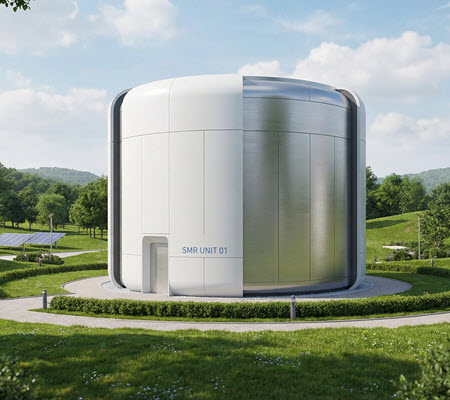
A small modular reactor (SMR) is an advanced nuclear power system that is larger than a microreactor but smaller than a traditional nuclear power plant. SMRs are built from factory-manufactured modules which can simplify construction and allow capacity to be added over time as power needs grow. SMRs span several reactor technologies, including light-water, high-temperature gas-cooled, and molten salt designs. They are being evaluated as a source of reliable, dispatchable power for utilities, industrial campuses, data centers, and other large energy users.
Firm natural gas generation is a dispatchable power resource capable of providing energy when needed to support critical operations and power reliability. It is frequently considered as part of a broader energy resilience strategy, providing reliable power to meet immediate and evolving energy needs while organizations evaluate advanced nuclear and other long-term firm power technologies.
Different advanced power technologies can play distinct roles based on project requirements, deployment timelines, economics, operational objectives, and technology maturity. The comparison below highlights how emerging and established firm power resources may complement one another as part of a broader energy resilience and infrastructure strategy.
| Technology | Typical Role | Key Benefit | Resilience Value |
| Microreactors (MMRs) | On-site power for remote or mission-critical facilities | Compact, factory-built, and designed to operate for years between refueling; Can be deployed in near-term | Supports energy security and operational continuity, independent of the grid |
| Small Modular Reactors (SMRs) | Utility-scale or campus-scale power generation | Modular design that allows capacity to scale with demand | Provides long-term, reliable power to meet growing demand |
| Firm Natural Gas Generation | Dispatchable generation available on demand | Mature technology with operational flexibility | Helps maintain critical operations during grid constraints |
| Renewable Energy and Battery Energy Storage (BESS) | Distributed power resources and emissions reductions | Reduces grid dependence | Support resilience when strategically integrated |
As organizations become increasingly dependent on reliable power, investments in resilient infrastructure, on-site generation, and energy security continue to grow. Advanced power technologies, including microreactors, small modular reactors (SMRs), and firm natural gas generation, may help organizations:
Military installations, critical infrastructure facilities, healthcare systems, industrial campuses, and data centers are increasingly evaluating these technologies as part of long-term strategies to enhance reliability, support operational continuity, and meet growing power demands.
Organizations are evaluating a range of advanced power infrastructure to support energy security, operational continuity, and long-term infrastructure planning. Microreactors, SMRs, firm natural gas generation, and other firm power resources represent several approaches under consideration as energy needs evolve.
Ameresco is a trusted partner with experience delivering integrated power infrastructure solutions in complex public-sector environments. As demand for reliable power grows nationwide, public-private partnerships can accelerate modernization of critical energy systems.
What is the difference between a microreactor and an SMR?
The main difference between a microreactor and an SMR is scale and application. Microreactors, also called micro modular reactors (MMRs), are the smallest class of advanced reactors. They are designed to be mass-manufactured in factories and deployed on-site to power a single facility, installation, or remote location. Small modular reactors (SMRs) are larger systems built from factory-manufactured modules. They are designed for utility-scale or campus-scale power generation, and capacity can be added over time as energy needs grow.
How do advanced power technologies support grid reliability?
Advanced power technologies can provide dispatchable or continuously available energy resources that help balance supply and demand, reduce exposure to grid constraints, and support critical operations during disruptions.
Why are organizations evaluating advanced nuclear technologies?
Organizations are exploring advanced nuclear technologies as they evaluate options to support long-term power needs, improve energy resilience, strengthen energy security, long-term pricing and provide reliable power for critical operations.
Why are military installations interested in energy resilience?
Military facilities often require reliable power to support mission-critical operations and maintain continuity during utility disruptions.
How do advanced reactors support energy security?
Advanced reactors are being evaluated for their potential to provide reliable, safe, long-duration power generation that can support critical infrastructure and reduce dependence on external energy supplies.
What role does natural gas play in energy resilience?
Firm natural gas generation can provide dispatchable power that supports reliability objectives and complements other energy resources.
How does grid capacity affect energy reliability?
When electricity demand approaches available capacity, grid stress can increase. Additional generation resources may help support reliability and resilience objectives.
What is the difference between energy reliability and energy resilience?
Energy reliability refers to the consistent delivery of power under normal operating conditions. Energy resilience refers to the ability to maintain critical operations and recover from disruptions such as outages, extreme weather events, or grid constraints.


 Designing Power: AI Is Creating a New Power Infrastructure Challenge
