October 14, 2026
Roseburg Urban Sanitary Authority and Ameresco Celebrate Completion of Energy Infrastructure Project

By: Fritz Feiten – Ameresco’s National Smart Streetlight Consultant
Share this post
Networked streetlight controls, commonly referred to as “smart streetlight controls”, are becoming increasingly recognized for their pivotal role in modern, smart and urban infrastructure.
As part of a Lighting Management System (LMS), these controls provide a wide range of benefits, from identifying malfunctioning lights to implementing energy-saving strategies. They do everything from grouping and scheduling lights to enabling strategies such as constant light output, late-night dimming, and more. There are many networked streetlight control options available in the United States.
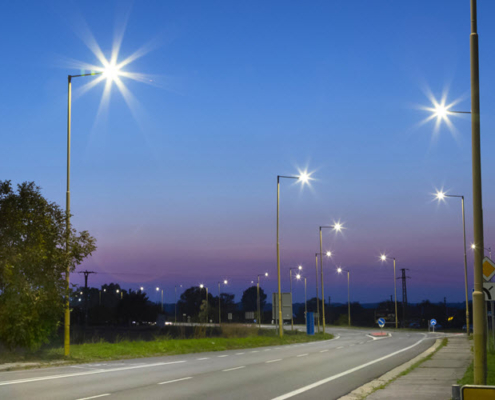
There are three main integrated components of an LMS: Smart Controller, Gateway and Central Management System.
Smart controller: This electronic device includes the hardware necessary to monitor and control the streetlight, determine its location (via a GPS chip), and communicate with the central management system (CMS). Additional controller features may include a capacitor to provide a “last gasp” alert to the CMS that the pole has lost power, a tilt sensor and/or accelerometer to monitor pole tilt or alert when a pole is hit by a vehicle, or the capability to monitor power quality, including sags and swells.
Gateway: This electronic device is used by systems that communicate via a mesh or star type network (see Network Communication below). The gateway (also called an access point or base station) communicates with individual controllers, acting as their communication “gateway” to the CMS. Gateways may be attached to poles, to streetlights, or other locations. For long range star networks, gateways are usually installed on towers. Backhaul communication between the gateway and the CMS is usually over a public cellular network, but fiber or copper can be used if available where the gateways are located. Cellular-based systems do not use gateways.
Central management system (CMS): The CMS is the software platform through which operators monitor streetlight performance, receive alerts, group and schedule streetlights, set dimming parameters, track energy use, and perform other related functions. The CMS is usually cloud hosted (very few vendors offer a customer hosted option). APIs provided by the vendor may be used to integrate the CMS with work order management, asset management, billing, 311 and other IT systems.
While the functions of a CMS are relatively common across the vendor community, the quality of the user interface, the number of steps required to accomplish a task, the availability of commonly utilized reports, the ability to customize functions, the robustness of the APIs, and other aspects of the CMS should be carefully considered.
Streetlight operations software enhances the economics of smart streetlighting, accelerating energy savings, increasing the efficiency of both initial deployment and ongoing maintenance, and maintaining data integrity across multiple platforms through integration of the CMS with work order management, asset management, billing and other back-office systems. Many cities, including Chicago, Philadelphia, Vancouver and London, and 8 of the 10 largest US utilities use TerraGo StreetlightOps to deploy and manage smart streetlighting.
Streetlight operations software includes mobile installation tools that speed installation and control commissioning (including associating lights with pre-set dimming schedules) and enable crews to accurately capture missing streetlight and pole data. Post installation, it consolidates and deduplicates related alerts, outages and customer calls to reduce truck rolls, enables remote trouble shooting of outages, assigns tickets based on proximity and route efficiency, and enable crews to turn on lights in the field to identify outages. Analytics and dashboards enable monitoring of contractor and crew compliance and productivity. Most importantly, it ensures data integrity across multiple back-office software platforms as streetlights are installed, removed or changed.
Vendors use a variety of network architectures to enable communication between controllers and the CMS. The primary ones used in the U.S. are LTE cellular, RF mesh and star networks, and hybrid solutions that combine a mesh or star network controllers with cellular controllers.
LTE cellular network: With this approach smart controllers communicate directly with the CMS via a mobile network operator’s (MNO) public cellular network (e.g.: there are no gateways). The MNOs use licensed spectrum, the technology is standardized, and the networks are managed by the MNOs to industry standards, providing a high level of security.
Since communications is managed by the MNO, the customer has no network management or network security responsibilities. Due to the greater volume of cellular connections and traffic, however, recurring costs are higher versus mesh or star systems. There are also differences in how vendors handle the commissioning of the controllers; with some offering a true self-commissioning capability and others requiring a second step of recognizing the light points in the CMS.
RF mesh network: An RF mesh network provides two-way communication between smart controllers and gateways. If a controller is out of range of a gateway, it will connect to the gateway through one or more other controllers (referred to as “hops”). The ratio of controllers to gateways varies by vendor and additional gateways are usually installed to provide redundancy (Chicago’s mesh-based network manages 280,000 streetlights with 60 gateways). In most cases, a network propagation study is completed to identify proposed gateway locations and gateways are installed before street light controllers are deployed.
Mesh networks are self-forming and self-healing, such that communication paths do not need to be pre-defined and if a controller or gateway fails (or is moved), the mesh will reform and maintain communication with the controllers. The backhaul connection between the gateways and the CMS is usually via cellular communication, however fiber and copper can also be used. There are a variety of mesh networks utilized for streetlight controls.
A mesh network is a private network and is usually owned, operated and maintained by the customer, though some vendors have an optional Network-as-a-Service offering. There are trade-offs between the higher recurring cellular communication costs associated with an LTE cellular network versus the greater initial deployment cost and management complexity of a mesh network.
RF star network: Whereas RF mesh is a short-range network, RF star networks such as UNB (Ultra Narrow Band) and others are long-range networks and require fewer gateways for a given number of streetlights. Depending on the vendor, these networks may use licensed or unlicensed spectrum. Unlike mesh networks, the communication path is direct from the streetlight controller to the gateway (no hopping), although with some systems a controller can also act as a mini gateway, enabling communication with other controllers that might otherwise be out of range. Like mesh networks, communication from the gateway to the CMS is via a cellular, fiber or copper connection.
As with a mesh network, the network is usually owned, operated and maintained by the customer, though some vendors have an optional Network-as-a-Service offering. As with mesh networks, there are trade-offs versus the LTE cellular network approach in terms of exchanging reduced recurring cellular communication costs for greater initial deployment costs and network management complexity.
Hybrid network solutions: Mesh and star networks do not work well in linear applications, such as highway lighting, as many more gateways are needed to form the mesh, increasing initial costs and network complexity. To address this, many mesh and star network vendors have begun offering cellular controllers that communicate directly with the CMS.
While the hybrid solutions offer increased flexibility and can potentially reduce the number of gateways required, they still rely primarily on a mesh or star network topology that requires gateways and is owned and managed by the customer (unless a Network-as-a Service option is purchased).
Networked street lighting controls are one of the most popular “smart city” technologies, providing significant, quantifiable benefits. These systems and the associated street light luminaires can also be a platform for deploying other smart city technologies, including environmental sensors, traffic monitoring, bicycle and pedestrian counting, monitoring of vehicle speeds, loading zones and parking violations, license plate reading, presence detection to raise light levels in response to activity and public Wi-Fi.
A relatively new entrant in this field (in the US) is the Zhaga Consortium, a global organization that aims to standardize components for LED luminaires, and the Zhaga socket, an inexpensive additional socket, usually installed on the bottom of the luminaire, that can accept a variety of environmental sensors and other devices. Used in conjunction with a DALI D4i driver and a smart controller, sensor data can be transmitted to the CMS. Zhaga sockets are currently offered on luminaires from Acuity Brands and Signify and other manufacturers plan to offer them. The City of Philadelphia is the first large city in the US to deploy Zhaga sockets city-wide on all cobra head luminaires.
## Originally published on POWERGRID International. ##
From embracing clean energy resources to implementing smart city technologies, municipalities are shaping a brighter future for the communities they serve. Learn about six unique paths taken by communities to become more sustainable while improving services and providing a cleaner environment for those they serve.
 Equity and the Clean Energy Transition
