
According to the U.S. Department of Energy, efficient energy infrastructure at K-12 schools can reduce annual operating costs by $160,000. This is a significant amount, considering that the annual energy bill to run America’s primary and secondary schools is $6 billion. Yet far too often in public and private school systems, cuts in faculty are considered over a reduction in energy expenses which are viewed as a non-controllable cost.
With services ranging from budget-neutral energy infrastructure upgrades to energy supply management to renewable energy, Ameresco delivers opportunities to upgrade energy infrastructure for K-12 schools. Through an Energy Savings Performance Contract (ESPC), Ameresco can design, build, operate and maintain new energy facilities and school upgrades with no up-front capital costs, collecting a portion of the energy cost savings while the remaining savings are kept by schools and put toward other expenses.
HVAC upgrades, interior lighting retrofits and asset management software can all help to improve facility conditions while lowering operating and maintenance expenses. Many K-12 schools are strong candidates for solar energy infrastructure that can meet on-site energy needs or be sold back to the grid as an additional source of revenue.
Ameresco utilizes both pure and applied research to work collaboratively with school boards and academic and facility staff to align, implement and monitor school renewal resources to enhance teaching and learning environments while creating energy-efficient schools. Ameresco can train school faculty to educate their students on behavior modification that can dramatically reduce energy use.
Interested in Learning More?
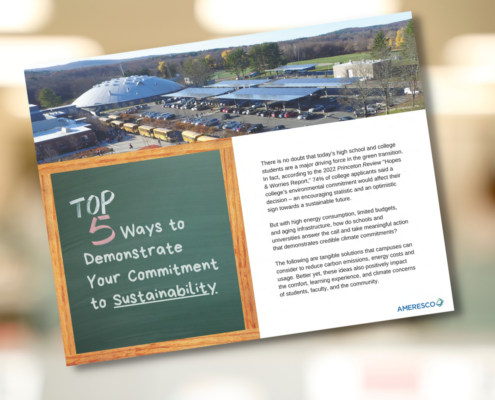
Top Five Ways to Demonstrate Your Commitment to Sustainability
Looking for tangible ways to reduce energy costs and carbon emissions of your campus? K-12 and university sustainability goals at top of mind? Need to address today’s climate-concerned students and faculty? Not sure how to finance the changes?

Project Highlights
Additional Resources
In this session, we will explore proven capital creation strategies to improve the deferred renewal gap and aging infrastructure challenge.

Learn how K–12 School Districts Cut Energy Costs and Modernize Aging Buildings.

Discover solutions that schools have utilized to save energy and costs that also opened up funding for educational programs.
